


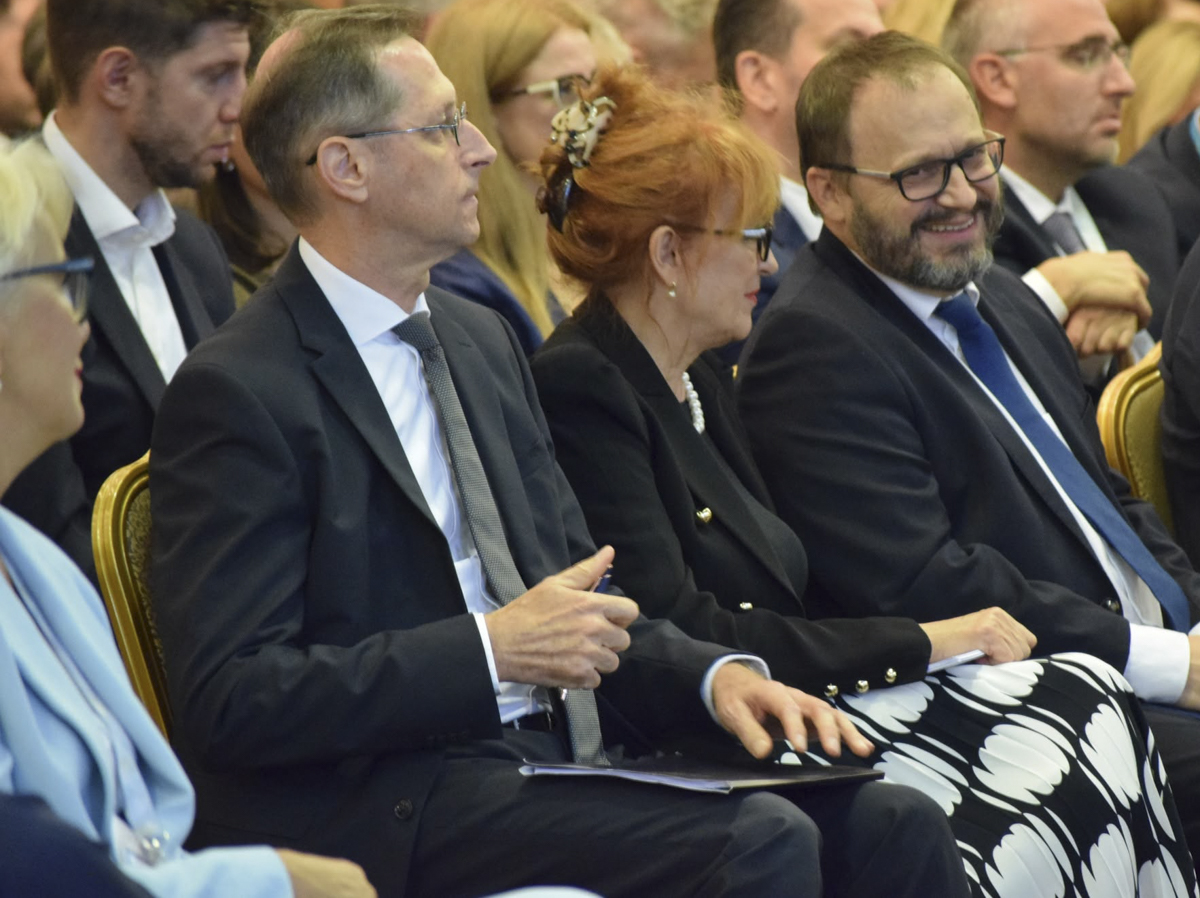
The 64th Itinerant Congress of Economists concluded successfully in Eger on Friday: around 700 participants attended the conference in person and heard the views of more than 80 speakers on the challenges facing the Hungarian economy. The conference’s live online broadcasts were viewed by nearly 18,000 people over the two days on the HEA YouTube channel.
Press coverage of the conference can be found here. A photo gallery of the event is available here. The presentations from the opening plenary session can be viewed at this link, while the section sessions are available here.
Long-term, predictable economic policy, bringing EU funds back to Hungary, and reducing the productivity and innovation gap are needed to sustainably improve the competitiveness of the Hungarian economy – emphasized Éva Hegedüs, President of the Hungarian Economic Association, at the opening of the conference. The President also highlighted the role of the institutional environment: a structure is needed that ensures a level playing field for market participants. The HEA President recalled that the Hungarian Economic Association was established 132 years ago with the aim of promoting the development of economic knowledge, providing a forum for the professional discussion of economic issues, and contributing to the development of economic policy thinking in Hungary. In her view, this mission remains unchanged today. One of the most important tasks of the association’s professional work, she said, is to create forums where different economic policy and professional positions can be confronted, while the participants in the debate approach one another with mutual respect. The conclusions of last year’s Congress were also summarized in writing and delivered to the then and current leaders of economic policy.
At the conference’s closing plenary session, Péter Ákos Bod, former Governor of the central bank and Vice-President of the HEA, summarized the key messages of the professional programs held over the two days. As he put it, the macroeconomic trajectory outlined by the government and soon to be submitted to Parliament can be achieved with a normal market economy. Péter Ákos Bod explained that the idea of a normal market economy “is not exactly brand new, but it is a little difficult to imagine, because we did not live in such a period.” Society has experienced one or two unpleasant episodes, he recalled, citing as an example the fact that in 2011 the state took people’s pension savings. “After this, it should come as no great surprise that the development of the Hungarian capital market is not like that of the Polish or Czech capital markets,” he said.
As another example, he mentioned foreign-currency lending, one of whose key moments was the plan to join the euro area, which ultimately – unlike most of the Maastricht criteria, and similarly to the legal independence of the central bank – was not fulfilled. He summarized that the event addressed a wide range of external and internal “shocks”, from demographics through artificial intelligence, movements in US government bonds, inflation data and rising petrol prices to the effects of the Russian-Ukrainian war. He described “the proximity of the euro” as the most significant announcement.
According to him, the proximity of the common currency has already manifested itself in savings of HUF 100 billion and will continue to do so. He believes that a kind of normalization would take place if the Hungarian economy used the European common currency, if the state did not interfere in the shaping of bank lending, and if prices were determined by supply and demand rather than by the authorities. He also included the reallocation of capital and labour within the economy along the lines of a kind of “creative destruction”.
According to Péter Ákos Bod, the topics discussed at the Congress presuppose that society will become more mature. As he put it, in the recent period, policymakers have sought to introduce changes in which nobody is worse off, while some will be better off.
At the same time, he pointed out that it is a major challenge at both the social and economic levels to accept and understand that “there is not enough for everything”. He also stressed that various interests are attached to the functioning of economic processes and mechanisms, and therefore “courage, strength and social maturity are needed for the beneficiaries to realize that this must come to an end”.
Everyone clearly sees that market-economy and competitive-economy mechanisms are needed, he emphasized, adding that it is important to teach people that nothing is free and that everything must always be taken into account in economic calculations. If this succeeds, Hungary will enter “a world of mature relations and the right incentives”, the Vice-President of the association concluded.
The Itinerant Congress of Economists is the largest annual conference of the Hungarian economics profession. The conference was held on Thursday and Friday at the Hotel Eger & Park, with around 700 professionals attending. The event focused on the current challenges of Hungarian economic policy. Particular attention was paid to the budget and the state of public finances, EU funds, the introduction of the euro, the banking system and credit market, the economic impact of artificial intelligence, and competitiveness.
In her closing remarks, Éva Hegedüs, President of the HEA, announced that the 65th Itinerant Congress of Economists will be hosted by the University of Miskolc on September 2–3, 2027.