


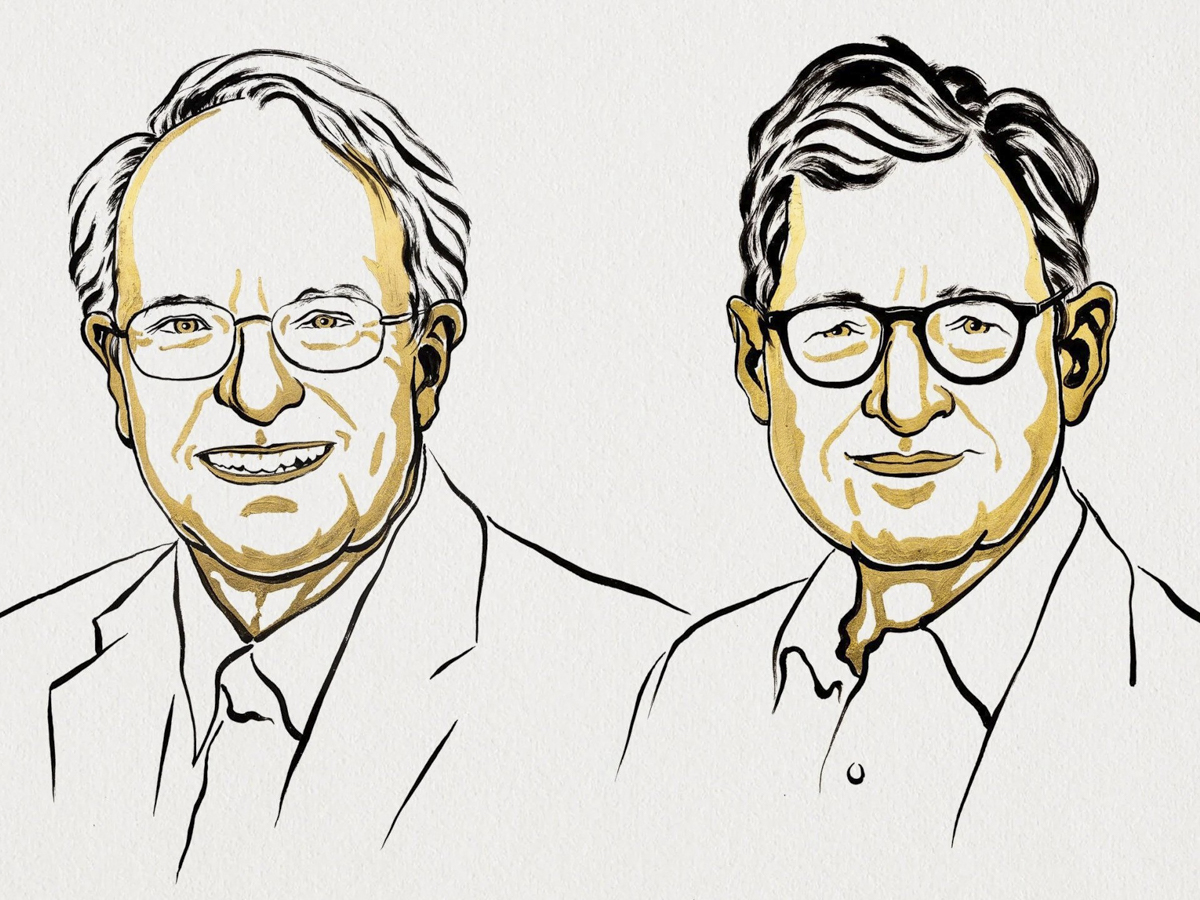
The models developed by the American scholars awarded this year’s Nobel Memorial Prize in Economic Sciences provide a basis for formulating state-of-the-art economic policy, drawing on microeconomic insights as well, economist and academician Péter Halmai, President of the Economic Policy and Economic Theory Section of the Hungarian Economic Association (HEA), told the Hungarian news agency MTI in an interview.
According to the decision announced by the Royal Swedish Academy of Sciences on Monday, Robert E. Hall and Michael Woodford will share this year’s Nobel Memorial Prize in Economic Sciences for their work on the microeconomic foundations of macroeconomic stabilisation. The citation states that the laureates developed new macroeconomic models that have significantly improved the ability to implement stabilisation policies effectively.
Economic fluctuations in market economies cause substantial losses. The fundamental objective of stabilisation policy is to prevent, manage and mitigate these fluctuations, including declines in output and increases in inflation, the academician explained. The laureates represent the New Keynesian school of thought. They moved beyond the original stabilisation policies based on Keynesian models, which had demonstrably become ineffective by the 1970s. One reason was that these policies assumed, among other things, that household consumption was proportional to total disposable income: in other words, that an increase in disposable income would automatically lead to higher consumption and, consequently, stronger aggregate demand. This linear approach was characteristic of traditional Keynesian thinking and was highly simplistic. The underlying assumption of the stabilisation policies of the time was that the relationships between macroeconomic variables remained stable, whereas in reality they did not, Péter Halmai explained.
The work of the laureates was inspired by examining fundamental macroeconomic variables, such as inflation, output and consumption, at the microeconomic level of households and businesses. Hall’s research indicates that expectations about future income are a key determinant of economic behaviour. In other words, a household’s spending and purchasing decisions depend partly on its income prospects. If these prospects are limited, the household will not spend as much of its income as conventional assumptions might suggest, he pointed out. He emphasised that, according to the Hall hypothesis, changes in consumption cannot be predicted in advance because they depend on unpredictable information.
Halmai added that Woodford developed a macroeconomic model based on microdata, one of whose important elements is a derivation of the determinants of consumption. Woodford’s model also demonstrates how consumption depends on interest rates. When interest rates fall, consumption may increase because the return on households’ financial assets declines. Thus, changes in interest rates can influence consumption.
One important lesson is that central banks can use interest rate adjustments to stimulate or restrain consumption and thereby expand or cool down the economy. This differs from the position represented by the quantity theory of money, which seeks to achieve these objectives solely by regulating the money supply.
Another fundamental dimension of the model is the behaviour of inflation. Corporate pricing decisions play a key role in this regard. Because of the relationships associated with what Keynes called price rigidities, companies’ expectations about the future are also of fundamental importance. Expectations concerning future interest rates are therefore crucial for inflation as well. Consequently, credibility and transparency are decisive for the effective functioning of a central bank, he stressed.
The second factor influencing inflation is the output gap. Woodford introduced this concept to describe demand pressures in the economy. Potential, or natural, output represents the economy’s supply capacity at which it can operate without disequilibrium. Actual output is typically either above or below this level. If actual output exceeds natural output, the output gap is positive, indicating that the economy is overheating. If actual output falls below the natural level, there is still room for balanced economic growth, meaning that the output gap is negative. Statistical offices report actual output, while potential output is estimated using econometric methods, he explained.
When the output gap is negative, stimulating demand does not have an inflationary effect. However, if demand is stimulated when the output gap is positive, this generates additional inflation without being able to increase GDP sustainably. One of the key functions of stabilisation policy is precisely to reduce or eliminate the output gap, he added.
According to Péter Halmai, these new models, which can be further developed and adapted, are already being used in practice. However, their existence does not guarantee protection against voluntarist policies—that is, policies that disregard facts and objective economic laws. As an example, he noted that in 2019, when the positive output gap amounted to 4.5 per cent of GDP, Hungarian policymakers were planning further economic expansion. Yet when the economy is already overheating, advocating further stimulus inevitably leads to inflation and a disruption of economic equilibrium, he pointed out.
The achievements of macroeconomics, including the application of the models discussed, may perhaps also encourage policymakers to exercise “a degree of humility”, because such humility primarily requires an understanding of economic laws and taking them into account. The interests of communities, nations and regional integrations can best be served by economic policies that adapt to reality, rather than by voluntarist approaches that attempt to make progress while disregarding it, Péter Halmai concluded.