


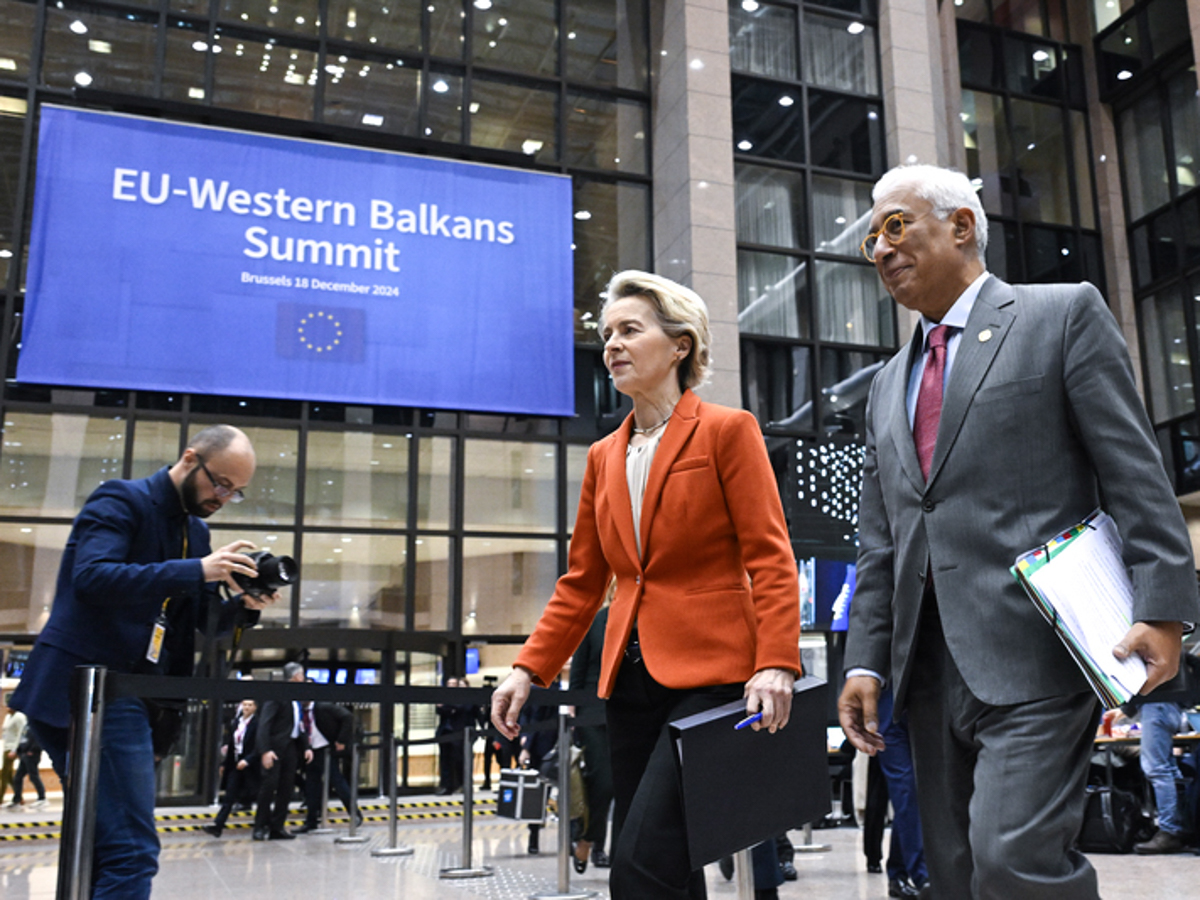
At a professional roundtable discussion held on April 30 by the EU Section of the Hungarian Economic Association (HEA), Péter Balázs—former Minister of Foreign Affairs, former European Commissioner, honorary member and former Vice President of the HEA—Zsolt Becsey, Associate Professor and former Member of the European Parliament, Vice President of the Section, and Ambassador Péter Mocsáry, EU integration advisor to the Government of the Republic of Serbia, analyzed the prospects and broader context of the European Union’s enlargement toward the Western Balkans. The discussion was moderated by Gábor Iván, Director at the Council of the European Union and President of the EU Section.
It was noted at the event that four of the region’s six countries—Albania, North Macedonia, Montenegro, and Serbia—have already opened accession negotiations with the EU, but progress has been slow and protracted. Péter Balázs pointed out that although the region is surrounded by EU member states, this circumstance has so far led to tangible and effective cooperation in only a few policy areas. Participants agreed that in the accession processes of the Western Balkan countries, political factors—rather than technical issues—play the decisive role.
The accession of the Western Balkan countries would not impose a financial burden on the European Union. However, there is currently little appetite for enlargement among the 27 member states; when future enlargement is discussed, Ukraine is usually the primary focus. If, at some point in the foreseeable future—and naturally following the adoption of the EU acquis—the countries of the region were to join, this would realistically only occur in a group format. This, however, would undoubtedly complicate the situation of countries that are further advanced in their preparations (currently, primarily Montenegro). In this context, Hungary’s first European Commissioner raised the idea of supporting the region’s catching-up process—likened metaphorically to being carried in a kangaroo’s pouch—thereby fostering development that could potentially accelerate integration. At the same time, it remains a fact that the complexity of institutional issues and sectoral policies within the EU does not facilitate progress in the enlargement process.
Due to its geographical position and its political and economic interests—including consideration of the Hungarian minority living in the region, whose population is gradually declining—Hungary can play an important supportive role in the Western Balkan countries’ convergence toward EU accession. At the same time, given the political considerations of the member states, it is clear that these opportunities should not be overestimated.
This summary was prepared by Imre Juhász, Secretary of the EU Section.