


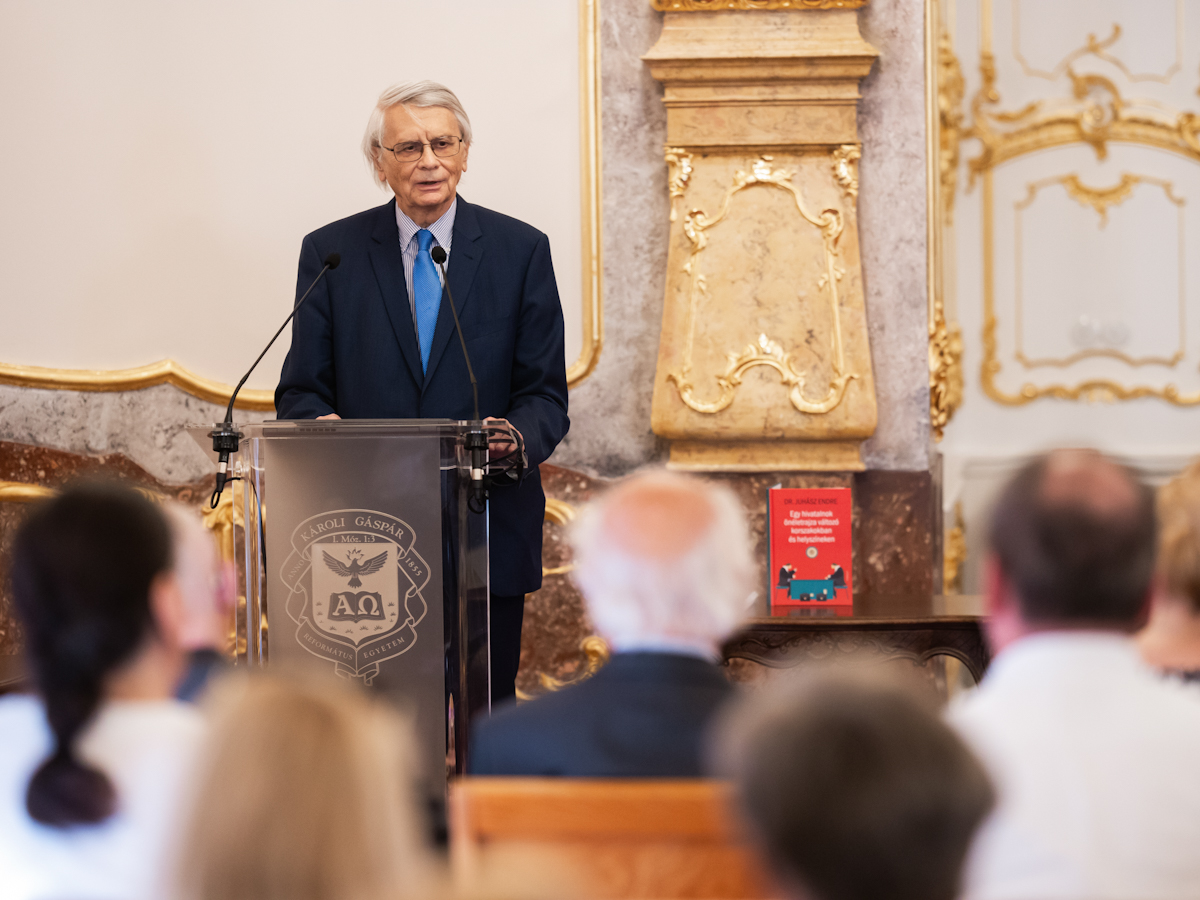
A Civil Servant’s Memoirs Across Changing Eras and Locations is the title of the autobiographical volume by Endre Juhász, Hungary’s former Ambassador accredited to the European Union, chief negotiator of Hungary’s EU accession talks, former minister responsible for European affairs, and former judge of the Court of Justice of the European Union. The book was published by Gondolat Publishing House. It was presented in Budapest on Tuesday, 9 June 2026, at an event jointly organized by the Hungarian Lawyers’ Association and the European Union Section of the Hungarian Economic Association, in cooperation with Károli Gáspár University of the Reformed Church in Hungary.
Those attending the event were welcomed by László Trócsányi, university professor, former Minister of Justice, President of the Hungarian Lawyers’ Association, and Rector of Károli Gáspár University. He described the volume as both a remarkable life story and a chronicle of an era and a family, spanning the period from the 1950s to the present day and following the author’s journey from his university years in Szeged to his judicial career in Luxembourg. He emphasized that the book is recommended to anyone wishing to understand the socialist period, the democratic transition, and later the worlds of EU accession and the European Court of Justice.
János Martonyi: Seven Decades of Friendship and an Unparalleled Historical Source
The book was introduced by János Martonyi, university professor and former Minister of Foreign Affairs of Hungary, who has known the author for nearly seventy years, since 1958. They were classmates at the Miklós Radnóti Secondary School in Szeged and later fellow students at the Faculty of Law of the University of Szeged. According to Martonyi, the book goes beyond the traditional memoir genre: it provides an accurate, objective, and precise account of a period that has now become history, while at the same time maintaining a deeply personal and committed tone. He highlighted the author’s decisive role as chief negotiator in the accession process and noted that the style of the book is inseparable from the author’s personality—echoing the famous saying that “the style is the man himself.” In closing, he reminded the audience that EU accession did not mark the end of history: questions of national and European identity remain on the agenda, and Endre Juhász’s knowledge and experience will continue to be needed in the future.
Péter Darák: The Meaning of “Civil Servant” and Five Personal Encounters
Péter Darák, former President of the Curia (Hungary’s Supreme Court), explored the linguistic and cultural history of the word civil servant. He traced representations of officials, clerks, and judges from historical artworks through the Baroque state servant to the burnt-out bureaucratic figure depicted by Honoré Daumier. He argued that none of these stereotypes applied to Endre Juhász and illustrated this point through five personal recollections, ranging from their first meeting with a judicial delegation in Luxembourg to professional consultations during his tenure as President of the Curia and friendly conversations at Lake Balaton.
He also recalled the 1993 foot-and-mouth disease case, when the European Community imposed an import ban on Eastern European meat products despite the absence of any outbreak in Hungary. At Juhász’s initiative, Hungary immediately introduced reciprocal restrictions, which led to the lifting of the ban within three weeks. The book discusses this episode in detail, and Darák emphasized that its lessons—the power of professional argumentation and the effectiveness of decisive action—remain relevant today. He concluded by stating that a civil servant is the face of the state, and that in Endre Juhász, the Hungarian state has shown its very best face over the past half-century.
Lajos Vékás: The Eras, the Author, and the Book
Lajos Vékás, university professor, full member of the Hungarian Academy of Sciences, and former Rector of Eötvös Loránd University, summarized his reflections in three points.
First, he spoke about the historical periods depicted in the book, periods of which the author was initially a passive witness in the 1950s but later became an active participant and shaper. Second, he addressed the author himself, who, in his view, appears in the book both modest and self-assured. The pages clearly reflect both his commitment to professional responsibilities and his awareness that his work contributed to a historically significant process. Third, he praised the volume itself, emphasizing that although it is primarily a professional work tracing the legal and diplomatic details of Hungary’s accession process, it is also highly engaging reading, filled with perceptive, occasionally critical, but always affectionate characterizations of European and Hungarian actors. He recommended the book to anyone interested in the history of European integration.
Zsolt Becsey: Courage, Honesty, and Educational Value
Zsolt Becsey, Associate Professor at Károli Gáspár University, former Member of the European Parliament, former Deputy Head of Hungary’s Mission to the European Union, and Vice-Chair of the EU Section of the Hungarian Economic Association, praised the book while recalling his own experience as the author’s deputy.
He highlighted the author’s courage in identifying by name the individuals involved in key decisions and in describing specific situations behind the scenes, as well as his honesty in discussing circumstances that members of his generation rarely address publicly. Becsey stressed the book’s value in higher education, arguing that it is an excellent resource for future lawyers, economists, and humanities students seeking to understand the history of Hungary’s relations with the European Union and the development of Hungary’s foreign economic policy. For this reason, he proposed publishing an English-language edition to make the work accessible to foreign and Erasmus students as well.
He also noted that the author drew a clear distinction between public service and party politics, highlighted the importance of trust received from superiors and extended to colleagues, and emphasized thorough preparation in negotiation techniques as one of the keys to successful accession negotiations.
Egon Dienes-Oehm: Friendship and the “Heroic Age” of Brussels
Egon Dienes-Oehm, former Constitutional Court judge and ambassador, as well as former Deputy Permanent Representative of Hungary to the European Union, delivered a personal reflection recalling his friendship with both the author and János Martonyi, dating back to their secondary-school years.
He attributed Endre Juhász’s exceptional qualities—which he described as “extraordinary class” and “omnipotence”—to his ability to move with equal confidence in the worlds of public administration, law, and international relations. Dienes-Oehm also recalled the years spent in Brussels between 2000 and 2004, which he described as a “heroic age” in the history of Hungarian diplomacy. In his view, the unparalleled prestige enjoyed by Hungary’s Permanent Representation during that period was due in large part to Endre Juhász and his team.
The Author’s Closing Remarks
Following the speeches, Endre Juhász expressed his gratitude for the publication of the 373-page volume, thanking in particular Gondolat Publishing House and its director, István Bácskai, for agreeing to publish the manuscript without special conditions. He also thanked the Hungarian Lawyers’ Association and the Hungarian Economic Association for organizing the event.
He added two remarks about the book. The first concerned the cover design, which—while acknowledging that some had found it controversial—he had personally approved, feeling that after two decades a degree of irony toward both the era and the work itself was permissible.
His second remark addressed the use of the word civil servant. He explained that the book was motivated primarily by personal and private considerations, but that one of his intentions was also to enhance appreciation for the role of the civil service in a public sphere that, in his view, too often focuses on the spectacle of high-level meetings while oversimplifying political and media discourse and overlooking the substantive professional work that actually takes place behind the scenes.