


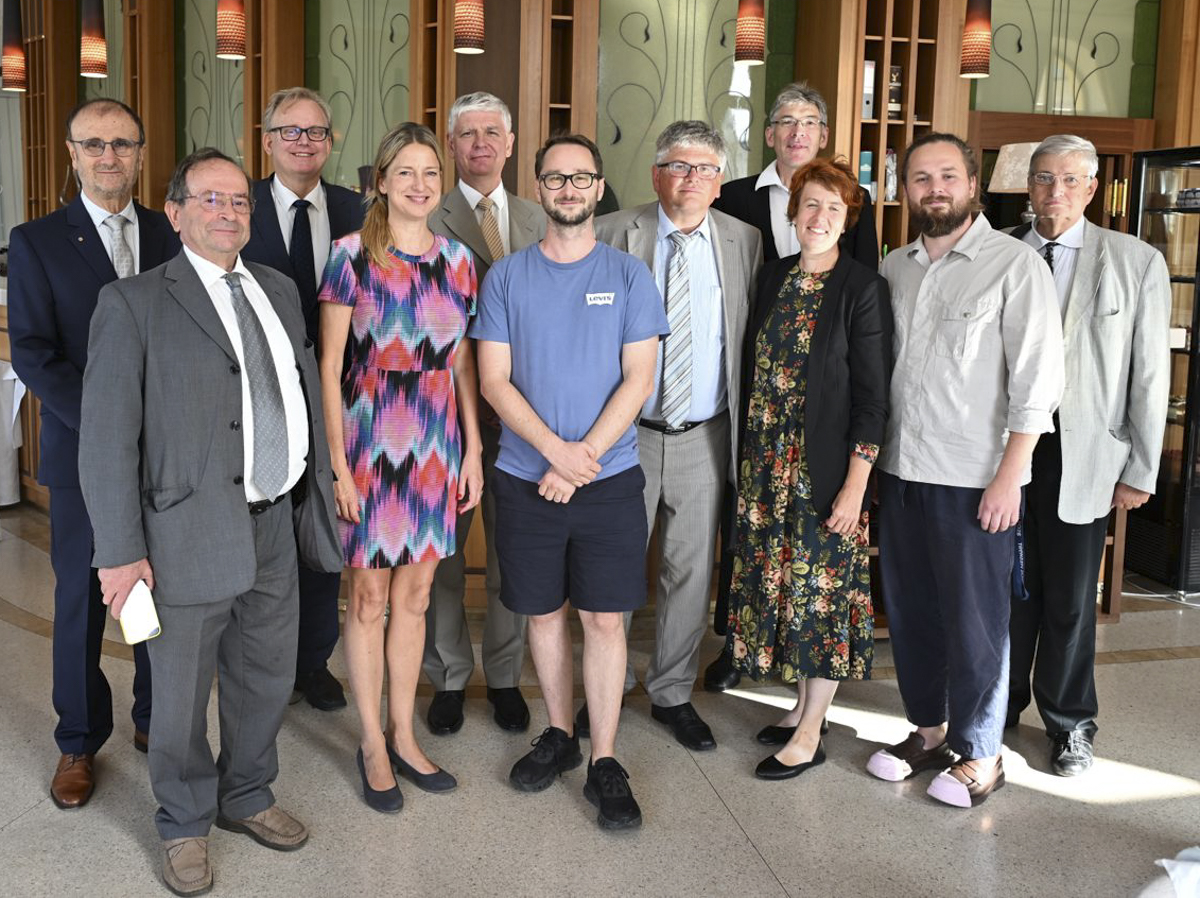
In the final days of August, the Board of the EU Section of the Hungarian Economic Association (HEA), accompanied by a small delegation, paid a visit to Trenčín, which this year holds the title of European Capital of Culture jointly with Oulu, Finland. The delegation was led by Gábor Iván, Chair of the Section, and included Board members Zsolt Becsey, Orsolya Szijjártó and Péter Mocsáry, as well as Imre Juhász, Secretary of the Section. It is worth recalling that in 2023, Veszprém–Balaton held the title of European Capital of Culture, an occasion with which the HEA’s EU Section was also associated through a professional visit.
Located in western Slovakia, approximately 240 kilometres from Budapest, Trenčín has a population of around 55,000 and is hosting a wide range of exhibitions, concerts, cultural events and gastronomic programmes with a European dimension throughout the year.
The HEA delegation was hosted first at a lunch and subsequently at a meeting by Stanislav Krajči, CEO of the Trenčín 2026 European Capital of Culture project; Patrik Zak, Deputy Mayor of Trenčín; Jan Vaclav, Head of the regional organisation of the Slovak Chamber of Commerce and Industry; Martin Mojžiš, Manager responsible for the European dimension and international relations of the Trenčín 2026 European Capital of Culture project; Iveta Niňajová, responsible for tourism and regional relations within the Trenčín 2026 European Capital of Culture project; and Lukáš Trnkóci, the Trenčín Region official responsible for education and culture and coordinator of the region’s European Capital of Culture project.
During the meeting, the Hungarian guests presented an overview of the activities of the HEA, including those of its EU Section.
The officials responsible for the European Capital of Culture programme in Trenčín had prepared a diverse and highly informative programme for the Hungarian delegation. Following an official lunch devoted to topics of mutual interest, the guests visited, among other sites, the city’s iconic castle, the Church of the Nativity of the Virgin Mary, and the synagogue.
On the second day of the visit, the delegation toured the RONA glassworks and its museum in Lednické Rovné, approximately 20 kilometres from Trenčín. RONA is Slovakia’s most significant domestically owned exporting company, employing more than 1,000 people. The official programme concluded in Dubnica nad Váhom (Máriatölgyes), with a visit to the former castle of the Illésházy dynasty, a family well known from Hungarian history.
The two-day programme provided an opportunity to gain insight into the cultural, economic and tourism background of the Trenčín 2026 European Capital of Culture project. At the same time, it highlighted that the city and its surrounding area, rich in historical sites and events, will remain well worth visiting even after the project comes to an end.
Further information: https://www.trencin2026.eu